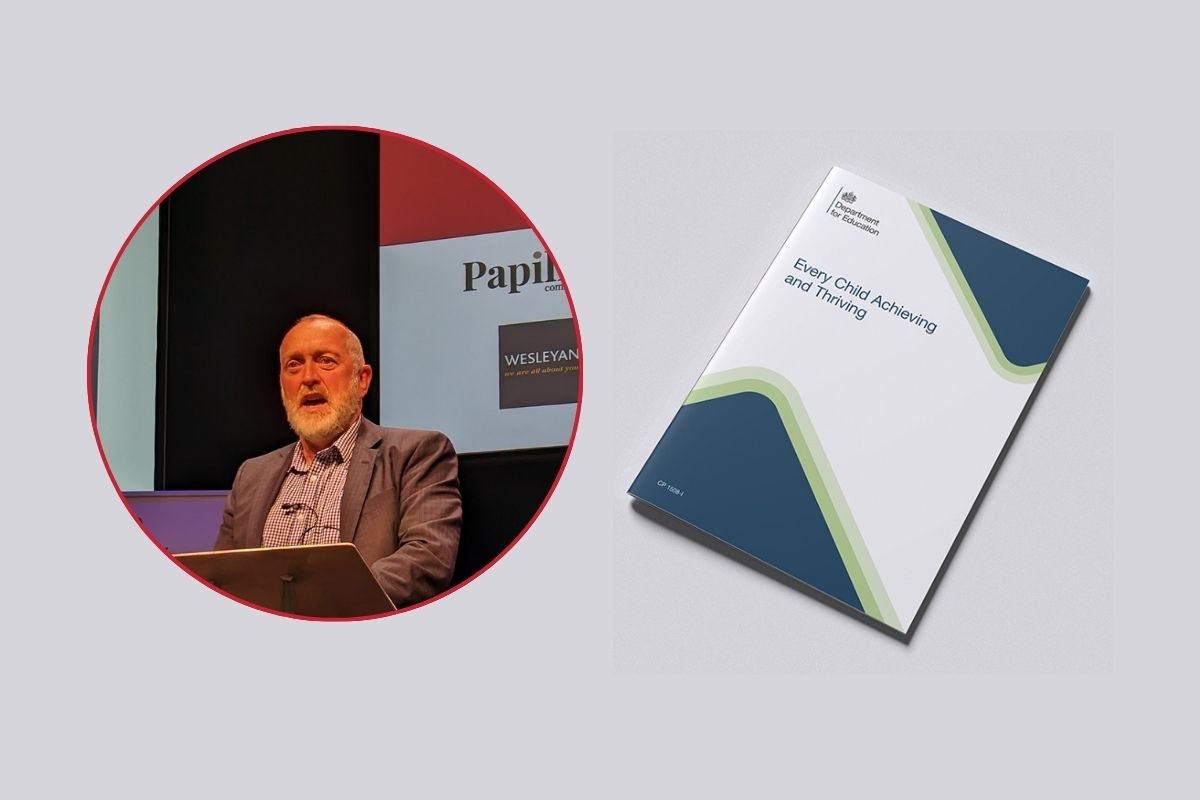
Sir Steve Lancashire is co-leader of the Being The CEO programme, and Chair of the National #TrustLeaders CEO network. He provides an enhanced mentoring offer to Forum Strategy’s networks members, including through the Being The CEO programme alumni group. Sir Steve will be chairing this Summer’s fifth annual ‘National #TrustLeaders Symposium: Pure Accountability – a new post-white paper reality?’ in Nottingham on 3rd June.
“Education reform is not a product launch. It reshapes governance, accountability and public expectation.”
Let me get something off my chest. Before this white paper was presented to Parliament, significant elements of it were trailed in the press. That may win a news cycle. It does little to strengthen my confidence in our democratic institutions. Education reform is not a product launch. It reshapes governance, accountability and public expectation. It deserves parliamentary scrutiny before press choreography. If we are entering a period of heightened accountability for trusts, then procedural integrity at the centre of government matters more, not less.
There, that needed saying.
Those of us who have led through successive policy cycles will recognise this pattern. Narrative travels fast. Detail takes longer. Our task, as ever, is not to react to the headlines but to interpret direction.
And yet, in terms of the White Paper, if we were looking, at long last, for a defining statement of educational purpose, a unifying “north star” for the next decade, we will not find it here. There have been moments in recent educational history when reform was anchored in an overt moral frame. The Every Child Matters agenda articulated a child-centred vision that reached beyond structures into wellbeing and life chances. Gordon Brown spoke explicitly about education as the engine of social mobility and national renewal. Whether we agreed with these sentiments and programmes or not, their animating purpose was unmistakable.
So, where does this white paper sit in the scheme of education reform and evolution?
This White Paper feels different. Its energy lies not in philosophical re-imagining, but in what I’m calling system recalibration.
Which is not to say that there isn’t good intent throughout the paper. The focus on inclusion, attendance, transition, community collaboration and disadvantage reflects serious legitimate concerns. Few of us would dispute the need to strengthen fairness, coherence and transparency. But this is not a white paper animated by a bold re-articulation of what education is ultimately for. It is a document shaped by an apparent need for consolidation. At heart, much of it is it’s a tidying-up exercise tightening where things have slipped, clarifying governance where it’s become fuzzy, expecting more consistency around inclusion and reducing the kind of outliers the system now finds hard to justify. It reads less as a generational reimagining and more as a system-maturing exercise and, to be fair, after such a period of radical structural reform, consolidation is understandable. Perhaps even necessary.
Its energy lies not in philosophical re-imagining, but in what I’m calling system recalibration.
But we should be clear about what this moment represents, a “strengthen and steady” agenda not a transformative philosophical reset.
There is, however, an undercurrent in this paper that as trust leaders we would be unwise to ignore. Across its pages, dashboards on pupil movement, trust-level inspection, governance intervention powers, a national data spine, clearer pooling transparency, tighter rules on executive pay etc there is a quiet but deliberate tightening of oversight and a widening field of scrutiny
Individually, each of these measures is defensible, many are sensible, some are overdue but collectively they signal something larger.
The state is becoming more present. Not through dramatic structural reversal, not through overt re-centralisation but through deeper data access, sharper scrutiny, and more conditional intervention powers. It is a centre that can now see more and intends to.
What does this mean for trusts relationship with the centre?
Before you tell me this as all conspiracy theory, for those of us who helped build the academy and trust movement on the foundational principles of autonomy and agency, this shift deserves attention.
Autonomy in the early years of the trust sector was a freedoms pass with certain expectations attached. It was a belief that schools, freed from certain constraints, would innovate responsibly and deliver better outcomes. This paper suggests that we are entering a different phase where autonomy can no longer be assumed to be the starting position. It has become conditional, predicated on transparency, alignment and demonstrable public value. That isn’t about blame or even judgement it’s simply the landscape we’re now operating in.
But it does create a tension.
Because the more oversight is normalised, the more the original premise, trust leaders exercising professional judgement within a framework of light-touch accountability, subtly shifts.
So what does this mean for us? Well, if autonomy is becoming more conditional, then the response from us as trust leaders cannot be nostalgic complaint. It must be maturity.
If we wish to preserve meaningful discretion at trust level, we must demonstrate, consistently and visibly, that it is deserved. How might we do this? Well, not simply by strong outcomes, but strong outcomes with fair intakes, not simply through compliance with the code, but by defensible practice, not simply though pooled efficiency, but by transparent explanation. Not simply in rhetoric about community, but in measurable civic contribution and community-enabling leadership. Not least captured and reinforced through pure accountability (which will be the timely focus of this year’s National #TrustLeaders symposium, by the way) And so on.
“many trusts are already modelling what this paper seeks to normalise”
Autonomy has never been the absence of accountability. It has been accountability earned through trust. And if the centre is tightening its grip, it is at least in part because confidence in the system’s self-regulation is uneven. So the real question for us, therefore, is not whether oversight is increasing, it is whether our practice makes further oversight unnecessary.
And it is important to say this clearly. Across the country, many trusts are already modelling what this paper seeks to normalise: admissions processes that withstand scrutiny, banding arrangements that are coherent and defensible, pupil movement decisions grounded in ethics rather than expedience. Reintegration is handled with care, community collaboration is substantive rather than rhetorical, resource pooling is clearly explained, and executive remuneration is proportionate and transparent. Pure accountability is increasingly being demonstrated by boards as a way of reinforcing shared endeavour with communities, and in securing formative and local accountability around what is collectively valued by all stakeholders.
Given this, the risk is not that the sector is incapable, it’s that we fail to surface and exemplify what good already looks like. If this White Paper marks a consolidation phase, then our task is not simply to comply with it. It is to make strong practice accessible, portable and systematic so that what works in pockets becomes the norm across the system.
“It means publishing clear public benefit narratives that explain how scale translates into opportunity for children. And it means being candid about what is not yet working”
That means strengthening collaboration not as an event, but as infrastructure. It means sharing disadvantage modelling and SEND practice openly across trust boundaries, not guarding it as competitive advantage. It means inviting peer review of admissions and inclusion processes before they are required. It means being transparent about pooling ,not simply publishing the numbers, but explaining the rationale. It means building genuine local partnerships with health, local authorities and community organisations not waiting to be convened but convening. It means ensuring reintegration processes are co-owned with families rather than administratively managed. It means developing executive pipelines, so leadership strength is visible beyond individual personalities. It means publishing clear public benefit narratives that explain how scale translates into opportunity for children. And it means being candid about what is not yet working particularly in attendance, disadvantage and inclusion and seeking support early rather than defensively. If we want autonomy to endure, then we must operate as if we are accountable not only for our own trust, but for the health of the system itself. That’s where pure accountability comes in, and why this Summer’s Symposium is such an important moment for us to come together as a network.
The key individual strands of reform
To do all this well, we need to understand what sits beneath this White Paper. Not simply what is proposed but what is intended. Once intent is understood, our response can become strategic rather than defensive. It’s probably, therefore, worth looking more closely at the individual strands of reform, not to rehearse the detail, but to understand the logic that runs through them. See this as a ‘If you haven’t read the 120 pages, this is what’s in them, part of the blog. (wink emoji)
SEND reform sits at the heart of the paper. The move towards a tiered system of support, with EHCPs restricted to the most specialist tier and new statutory plans for others, signals an attempt to rebalance inclusion towards mainstream provision. The significant funding commitments, the Inclusive Mainstream Fund and the “experts at hand” model, suggest the government is trying to strengthen capacity before crisis point, if we haven’t reached that already. The intent is clear: fewer children reaching statutory escalation, more needs met earlier, and a more sustainable system.
“The reassurance we were seeking from the government about their commitment to trusts and the academy sector has (probably) finally arrived here, though as ever the mechanics or levers to achieve this are missing.”
The expectation that all schools will be in trusts is framed less as structural revolution and more as consolidation. The intent appears to be coherence and shared accountability, reducing fragmentation while allowing flexibility on scale. The encouragement for local authority and partnership-led trusts signals a recalibration of the relationship between the centre, trusts and place. The reassurance we were seeking from the government about their commitment to trusts and the academy sector has (probably) finally arrived here, though as ever the mechanics or levers to achieve this are missing.
Executive pay transparency is, at its core, about public confidence. In a publicly funded system, visible proportionality matters. The language of justification and restraint reflects a political judgement that legitimacy is strengthened when remuneration is clearly aligned to scale, responsibility and impact. Few of us would argue with that principle. But it also places a premium on boards being able to articulate, convincingly and publicly, the complexity and accountability inherent in leading large, multi-school organisations.
The emphasis on disadvantage reform, including the ambition to halve the attainment gap and the move towards a more nuanced funding model, signals a determination to bring greater precision to how need is identified and resourced. Moving beyond blunt eligibility markers towards a more graduated understanding of poverty reflects an intent to sharpen targeting and strengthen accountability for impact.
The accompanying area-based missions reinforce that logic. A recognition that disadvantage is not only individual but geographic, shaped by coastal economies, regional inequality and community context. The intent here is not uniform national prescription, but structured, place-based collaboration grounded in local need.
Attendance targets and reintegration reforms extend this focus. A 94 per cent ambition is not a technical adjustment; it is a cultural signal. Attendance, behaviour and belonging are being reframed as shared responsibilities, requiring schools and families to operate in partnership rather than in transaction.
Similarly, proposals around parental engagement and complaints reform reflect an acknowledgement of rising friction between schools and communities. Standardising expectations and processes is intended to rebuild clarity and trust though, as ever, implementation sensitivity will matter.
Workforce measures, from recruitment and retention incentives to maternity reform, point to a recognition that none of these ambitions can be realised without stable, confident staff. Policy aspiration is ultimately mediated through human capacity.
Leadership development measures sit alongside this, signalling that leadership quality remains a decisive lever in system improvement. Coaching, standards review and targeted incentives reflect an understanding that culture flows from the top.
Finally, the proposed data spine and digital platforms illustrate the drive for greater coherence in information flow. Reducing fragmentation and aligning oversight more systematically speaks to the broader theme of visibility that runs through the paper.
There is more on the implications for trust strategic development, including growth and accountability, from Forum Strategy’s Policy Lead, Sarah Ginns, here: ‘Separating the wheat from the chaff’ in the new Schools White Paper | Forum Strategy
What are the implications for CEOs in their role?
“Autonomy cannot sit quietly in the background as an assumption as it once did. It has to be exercised deliberately and explained clearly.”
So, as I said earlier, taken together, these strands do not amount to ideological disruption. They amount to system tightening. The through line is consistent: greater precision in targeting need, clearer lines of accountability, stronger partnership expectations and enhanced visibility across the system.
So, the fundamental question, of course is, what does this all mean for us as CEOs? Lots, of course, but let me focus on three of the biggest implications; ethical, visible autonomy, deep, disciplined inclusion, place-based system design and stewardship
Firstly, we now have to think differently about autonomy and that starts with ethics. Only ethical behaviour will do, and that is right and proper. Autonomy cannot sit quietly in the background as an assumption as it once did. It has to be exercised deliberately and explained clearly.
That changes how we behave.
“It means inviting scrutiny rather than waiting for it, including through embracing ‘pure accountability’ once and for all”
It means writing board papers that make our reasoning explicit. It means being proactive about transparency rather than reactive. It means inviting scrutiny rather than waiting for it, including through embracing and generating localised ‘pure accountability’ once and for all, through formal levers – such as proposed trust benefit accounting – and less formal ones. It means testing our decisions against a simple question: would we be comfortable defending this publicly?
In this phase of the system, autonomy isn’t something we can hold quietly; it’s something we must demonstrate consistently.
Secondly, we have to think more deeply and creatively about inclusion. Not as an aspiration, but as a matter of executive judgement. It cannot sit at the margins of strategy or be delegated neatly elsewhere. It has to shape how we define success. That means interrogating our own patterns, attendance, exclusions, admissions, pupil movement, access to enrichment , with the same rigour we apply to attainment data. It means identifying where vulnerability is emerging and intervening early, not when pressure forces our hand.
It also means ensuring that inclusion is operationally decisive, not merely structurally sound. It cannot exist as a set of initiatives alongside “core” strategy; it has to inform how we design the organisation itself, how pupils enter, experience and progress within it, how decisions are made and how success is measured. And beyond structure, it must influence judgement. When trade-offs arise, and they always do, inclusion has to carry weight in how we resolve them. If there is a gap between what we say about serving all children and how our choices actually play out, that gap will become more visible. In this phase of the system, inclusion becomes a question of coherence: do our decisions and actions reflect our stated intent?
“we now need to see ourselves not only as leaders of Trusts, but as builders of local educational blueprints.”
Thirdly, we must fully embrace the opportunity to shape the system at locality level. This is bigger than partnership and bigger than collaboration. The direction of travel is towards joined-up provision where children and families experience education, support and safeguarding as coherent rather than fragmented. We are uniquely positioned to design that coherence, and we now need to see ourselves not only as leaders of Trusts, but as builders of local educational blueprints. That means aligning phases deliberately, smoothing transitions, strengthening alternative pathways and working with health, social care and local authorities to create seamless support around children. It means thinking beyond institutional performance towards continuity of experience. Where are the fractures in our locality? Where do families fall between agencies? Where does provision feel disjointed? Those are now our leadership questions.
There are moments in any system’s life when it must move from energy to endurance, from expansion to responsibility. This feels like one of those moments. The early years of reform were characterised by pace, structural change and the creation of new freedoms. What has followed is different. We are now being asked whether those freedoms can be exercised consistently, ethically and in service of something larger than individual institutional success.
That is not a diminishment of the model we all work within. It’ s the proving ground and I am confident that our sector is capable of meeting that test. Across the country, there are trusts already modelling visible integrity, disciplined inclusion and genuine place-based leadership. If we choose to lean into this phase and make our judgement clearer, our systems more coherent and our contribution to place more deliberate then this consolidation will not constrain us. It will refine us. Pressure does not weaken strong systems. It reveals them. And when expectations rise, so too can our standard of leadership. It’s a great time to be CEO.
Sir Steve Lancashire is co-leader of the Being The CEO programme, and Chair of the National #TrustLeaders CEO network. He provides a enhanced mentoring offer to Forum Strategy’s networks members, including through the Being The CEO alumni group. To find out more about this, please email: admin@forumstrategy.org