
As we head towards Christmas, it’s that time of year again where we share our annual survey of academy trust CEOs. Here are the headline findings from this year’s report…
The sixth annual #BeingTheCEO survey took place in October and, yet again, it provides some valuable insights for leaders and for the wider sector. It also helps inform the continuous development of both the #BeingTheCEO programme – heading into its eighth year in 2026, and the National #TrustLeaders CEO network.
As with last year’s survey, we have interviewed around fifty CEOs, more than half of whom have now been in the role for five years or more. As a result, this is a survey that is grounded in experience and long-term perspective when considering the current context for CEOs, trusts and the sector generally. That said, we’ve also gathered the perspectives of those relatively new to the role, but generally not those in the first year (which can often be about settling in and coming to terms with the job and its implications).
So, what are the headlines from this year’s report?
1. There’s an even greater emphasis on ‘managing politics’
When taking on the CEO role, the key shifts, as you would expect – and, as previous surveys have told us – are leading a more diverse team of professionals; being more strategic in terms of deploying resources and making the right investments in the organisation; the level and nature of working with the board; and being more outward-facing.
However, this year, the expectation of managing and engaging with the political environment is greater. This should not be unexpected, trusts are still designated by the ONS and the Cabinet Office as central government bodies, and operating within that eco-system is inevitable. What’s more a new government with a big and pacey policy agenda, the rise of RISE, and the increase in mergers, has probably all contributed to this sense. What is for sure is that we need to be clear that supporting trust leaders to understand their role within and relationship with this eco-system, and how to approach those critical relationships with government and politicians in a way that is appropriate and manageable, has never been more important.
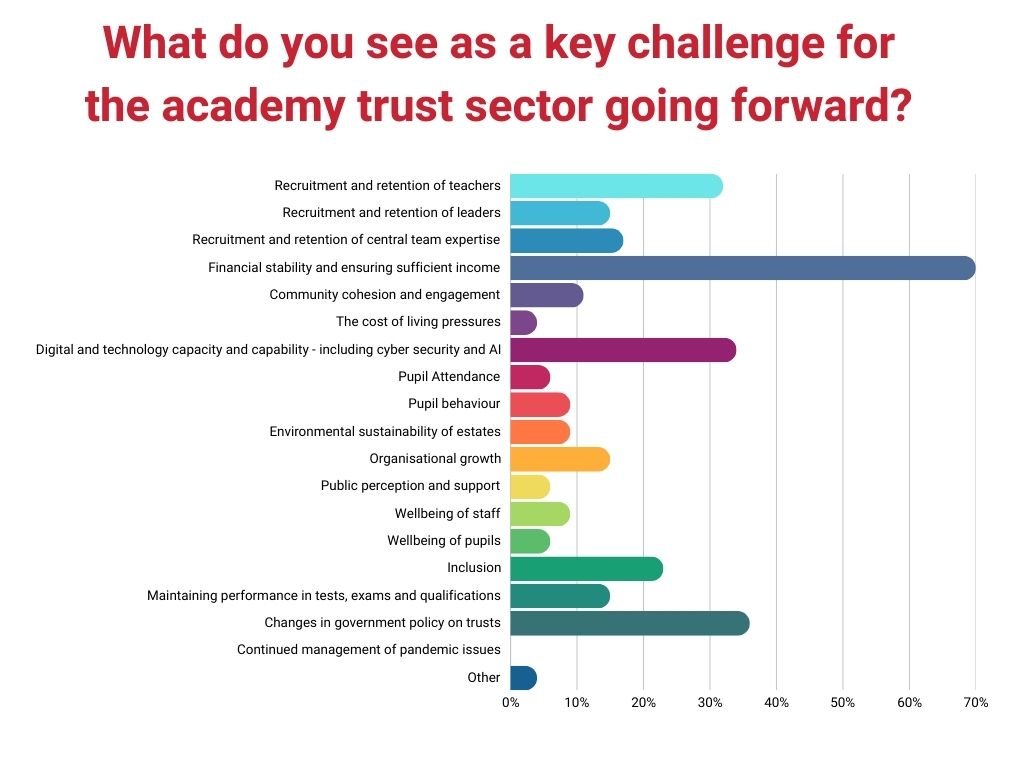
Indeed, as we will see later, changes in government policy are perceived as one of the biggest challenges for the academy trust system currently.
FURTHER READING FOR FORUM STRATEGY MEMBERS: Influencing, informing and engaging the influential as a CEO. | Forum Strategy (Professor Toby Salt)
2. There’s been a real shift in perception on the necessary background of a CEO
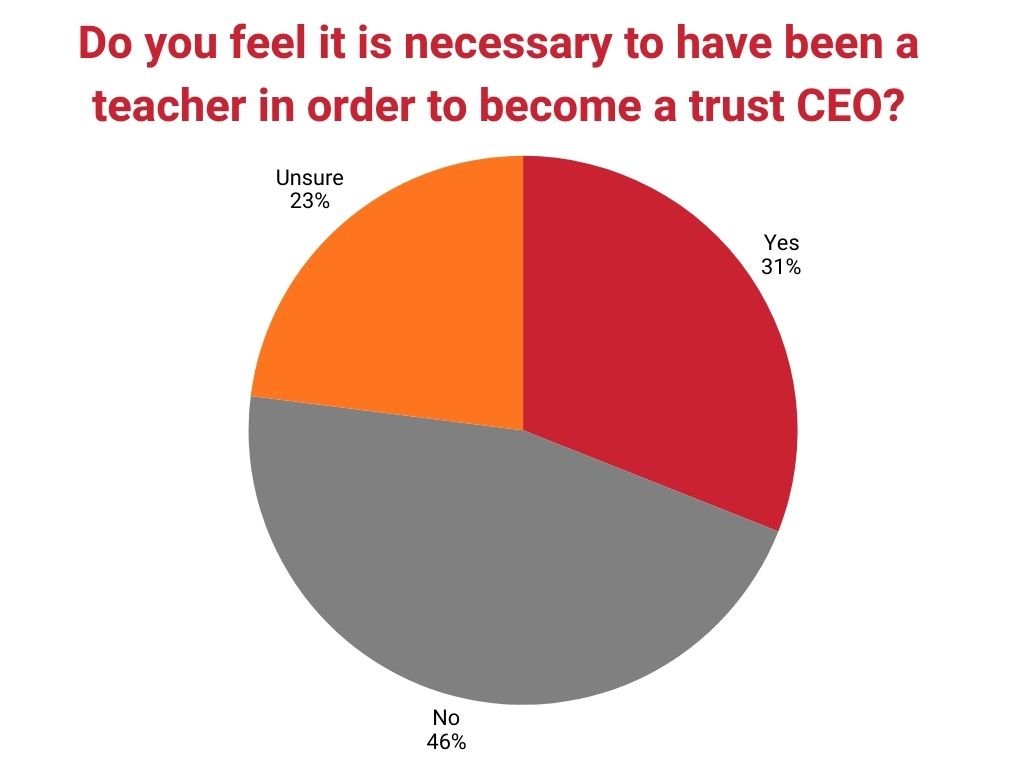
When we first began this survey back in 2020, only a minority of CEOs were of the view that someone of a non-teaching background could step up to the role. That perception has shifted significantly, and it is now the case that only just under a third of CEOs are of the clear view that you need to be a teacher to be a trust CEO. It should also be stated that over 80% of those completing the survey were teachers by profession, so this isn’t simply a change driven by more non-teacher CEOs completing the survey. It’s a genuine shift in perception, brought about by the fact that many non-teacher CEOs are leading their trusts with impact and success, and often leading on innovation in numerous areas from which the wider sector is learning. This acceptance of CEOs coming from a variety of professional backgrounds and experiences now reflects wider perceptions in sectors such as the NHS and the third-sector. It certainly enhances the capacity and diversity expertise of the sector as a whole, especially when we consider the growth of trust to trust working and support.
FURTHER READING: Academy trust CEOs don’t need a teaching background (Pain, 2019)
3. Finance remains a big challenge, but it’s not dominating CEOs’ agendas
When we asked CEOs what the main challenge was for the academy trust system going forward, by far the majority cited its financial sustainability and adequate funding. This is unsurprising and continues last year’s trend. However, other issues featured prominently too, including changes in government policy, digital transformation (including AI and cyber security), the recruitment of teachers, and inclusion.
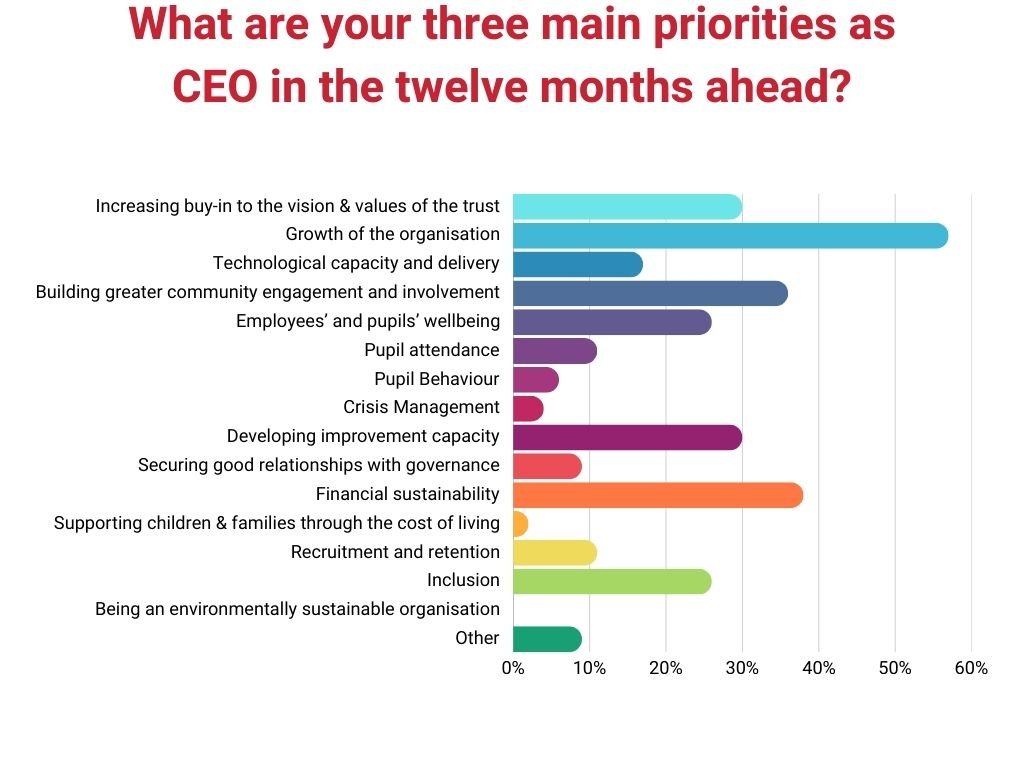
The fact that finance dominates as the big challenge for the sector does not mean it is eclipsing CEOs’ other key priorities. They are recognising what is within their circle of control. Of course, CEOs are focused on addressing and mitigating the financial challenges, but it seems they are also mainly focused on issues such as growth of the organisation; developing and embedding community involvement and participation in the work of their trusts (a big theme for Forum Strategy in terms of building sustainable and impactful trusts); securing buy in to the trust’s vision and values across schools; inclusion; and developing improvement capacity across the organisation.
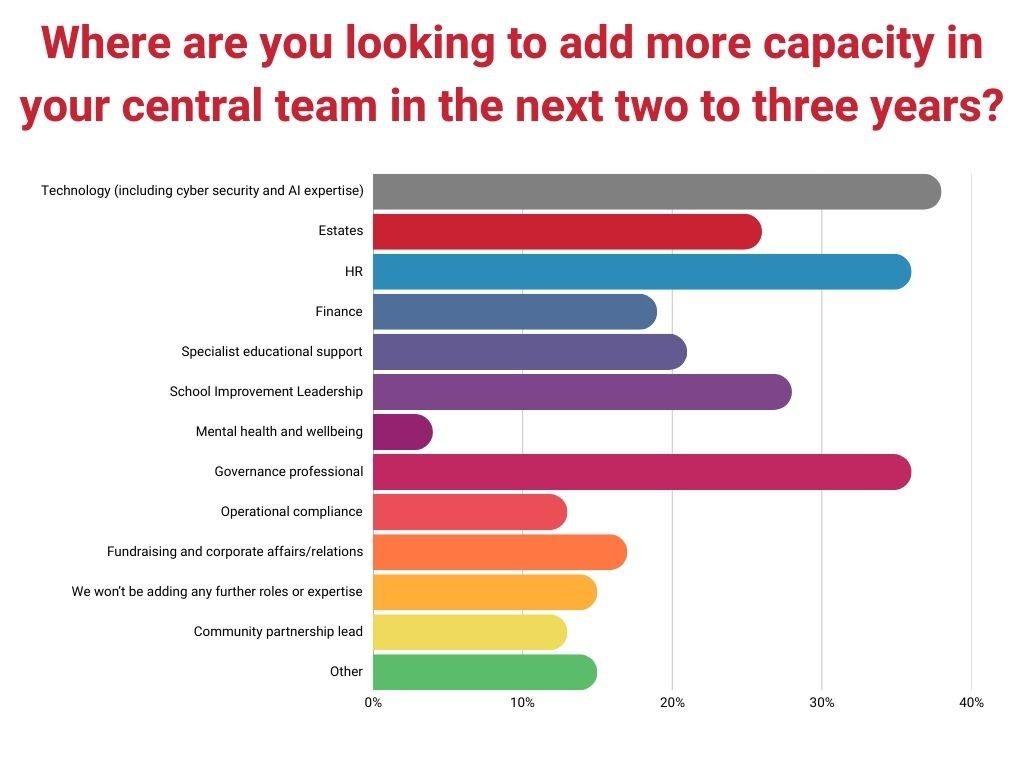
On a related note, only 13% are not considering adding capacity to their central team. Where they are doing so, the areas most cited for capacity building are around digital technology and HR expertise, reflecting the key priorities of digital transformation and securing strong recruitment/retention. The intention to add a governance professional is also high.
FURTHER READING FOR FORUM STRATEGY MEMBERS: Summer ‘Long Read’: why we need to re-conceptualise trust growth | Forum Strategy
4. Community-enabling leadership is rising up agendas, with a clear sense of the role of pure accountability
The theme of this year’s National #TrustLeaders CEO Conference was community-enabling leadership, and its role in ensuring trusts can secure sustainable solutions to big issues, not least attendance, behaviour, parental engagement, curriculum enrichment, capacity building in an era of stretched resources, and cohesion. This onus on community participation is reflected in a general trend across the wider economy, as organisations increasingly recognise that their evolution and relevance depend on actively and purposefully involving stakeholders in their development, improvement and innovation.
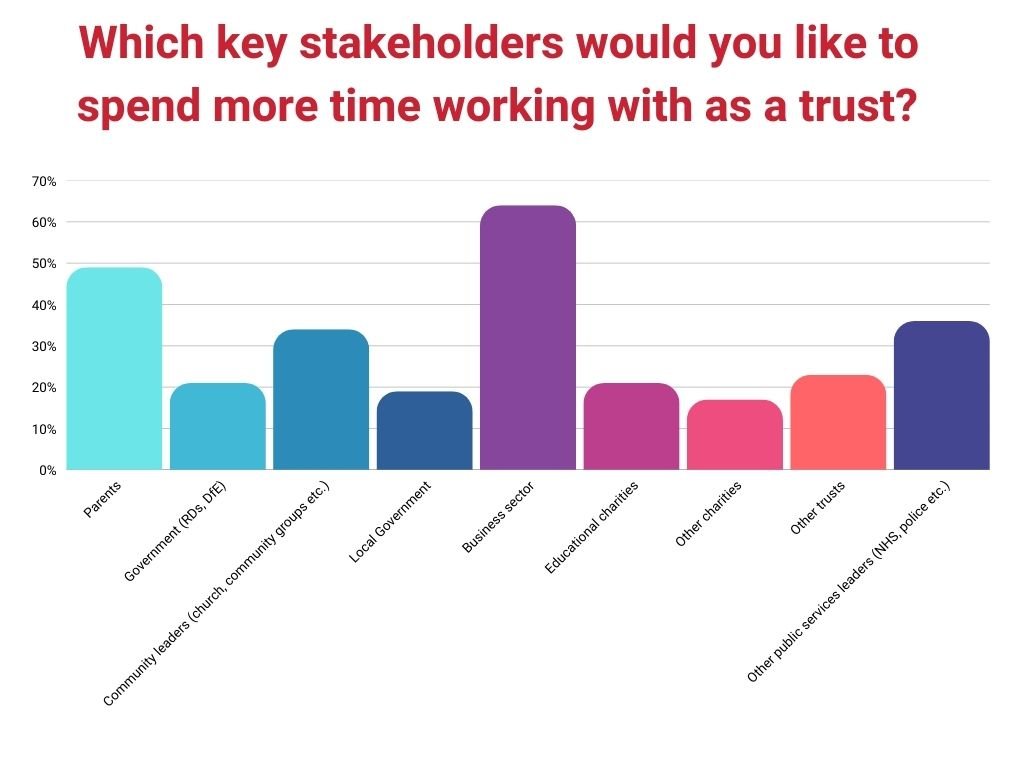
As with previous years’ surveys, more CEOs want to engage with both businesses and parents. Indeed, this reflects two of the most important stakeholders in seizing the opportunities and addressing the key challenges of the moment. CEOs clearly wish to do much more on this front, and time and capacity would seem to be one challenge holding it back. That said some activity is clearly happening (as we will see in the next paragraph), they just appear to wish to be doing even more of it. Understanding how trust leaders and trusts generally can deepen their partnerships with parents and business in order to secure greater impact is something we are committed to working on as we build on the theme of community-enabling leadership in 2026 and beyond.
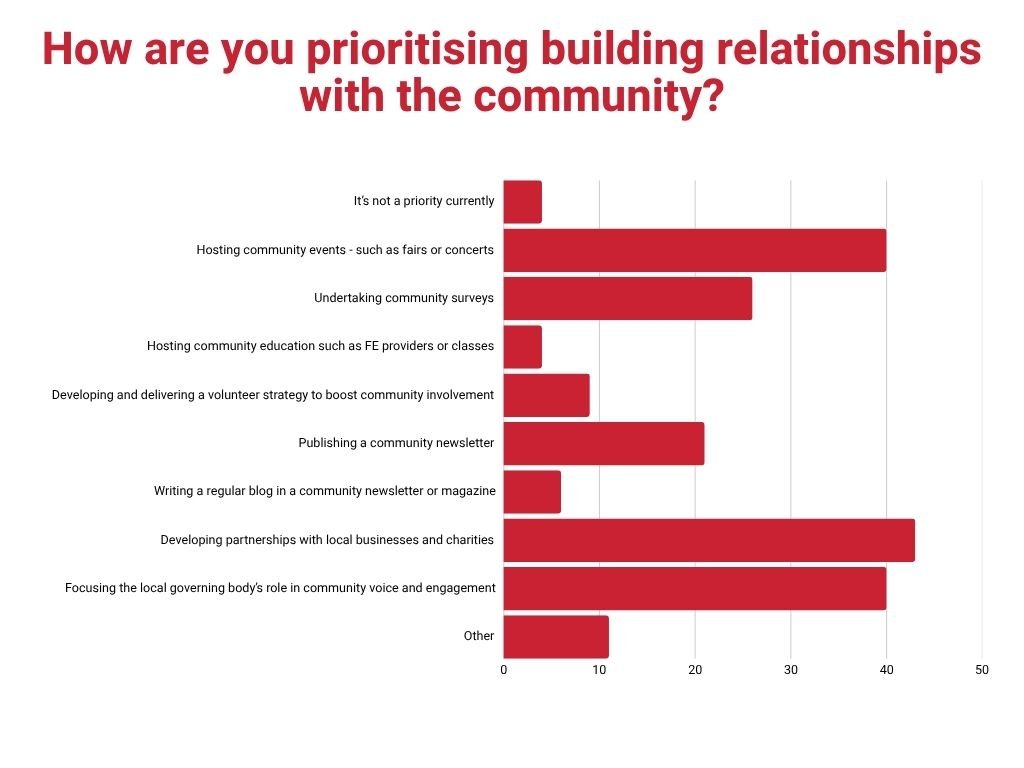
CEOs are taking forward a number of strategies in response to the importance of community-enabling leadership, with developing partnerships with local businesses and charities to deliver educational and extra-curricula provision being the must cited (42%), closely followed by trusts focusing the role of local governing bodies in ensuring community voice and engagement (40%) and hosting community wider events such as fairs and concerts (40%). However, it does seem that there is great scope for more communication with communities, with only a very small minority of CEOs producing a community-orientated newsletter or writing a regular article or blog for an external community paper or newsletter. These approaches can greatly enhance visibility and opportunities for community engagement and partnership, as part of narrative sharing.
FURTHER READING: Michael Pain’s Keynote Speech to the National #TrustLeaders CEO Conference 2025; Community-enabling leadership is the leadership priority of a generation.
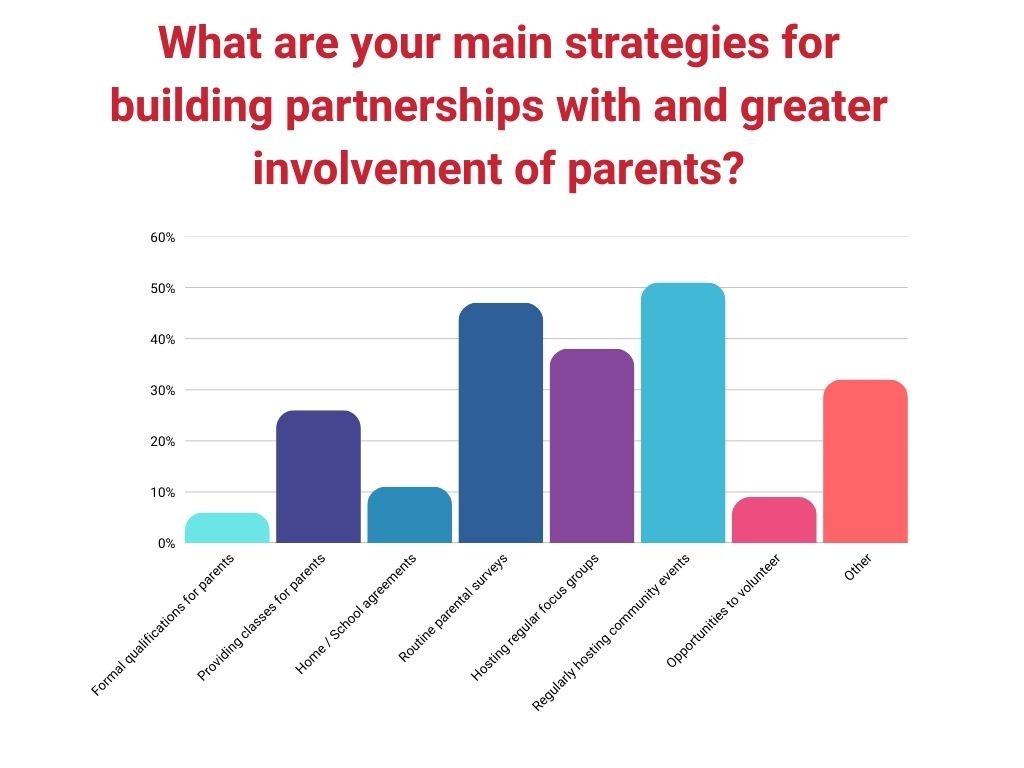
On that note, CEOs’ growing prioritisation of community-enabling leadership is reflected in some of the strategies they are using for building participation, such as hosting community events in trust facilities (49%); undertaking routine surveys of parents (43%); hosting regular focus groups (36%); and providing classes for parents in areas such as reading, technology of otherwise (26%). Interestingly, it seems home school agreements with parents, which haven’t been statutory for some years now, are only used by a small minority as a strategy setting expectations for parental involvement and participation (11%).
Building on this theme further, Forum Strategy has been clear that pure accountability (a formative, real time, and trust-generated approach to its own and its stakeholders accountability for working towards a shared vision), is a key strategy for building participation and collective commitment amongst all involved in the life and work of a trust – including parents and carers.
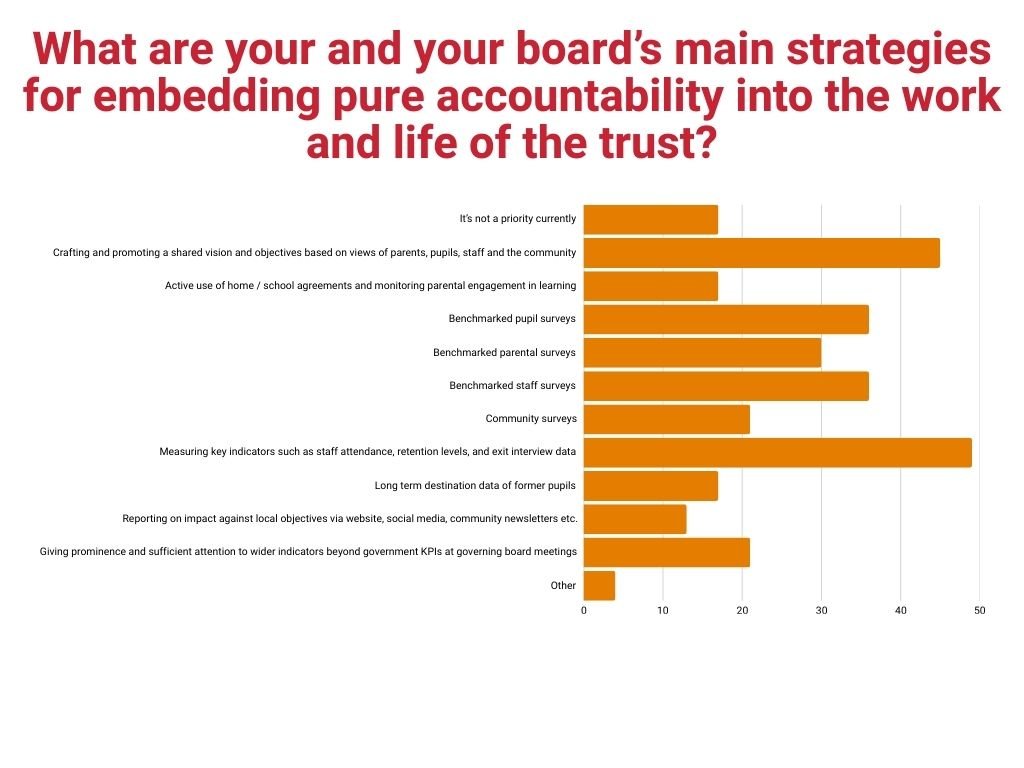
CEOs were asked how they and/or their boards were putting pure accountability into practice. Encouraging only 13% said this was ‘not a priority’ for them. The majority now see this as key, and using approaches to embed it such as attaching significance to wider indicators such as staff attendance, retention levels, and exit interview data (45%); ‘crafting and promoting a shared vision and objectives based on views of parents, pupils, staff and the community’ (41%); and routine and benchmarked pupil (33%), staff (33%) and parent and carer surveys (30%). Again, the use of ‘home school agreements’ to reinforce mutual responsibility and accountability is a strategy only used by a minority (17%), as is measuring destination data of former pupils to remain accountable for long-term outcomes (17%).
FURTHER READING FOR FORUM STRATEGY MEMBERS: In Practice Guide: Pure Accountability | Forum Strategy
5. CEO development is about high-quality networks of learning and support
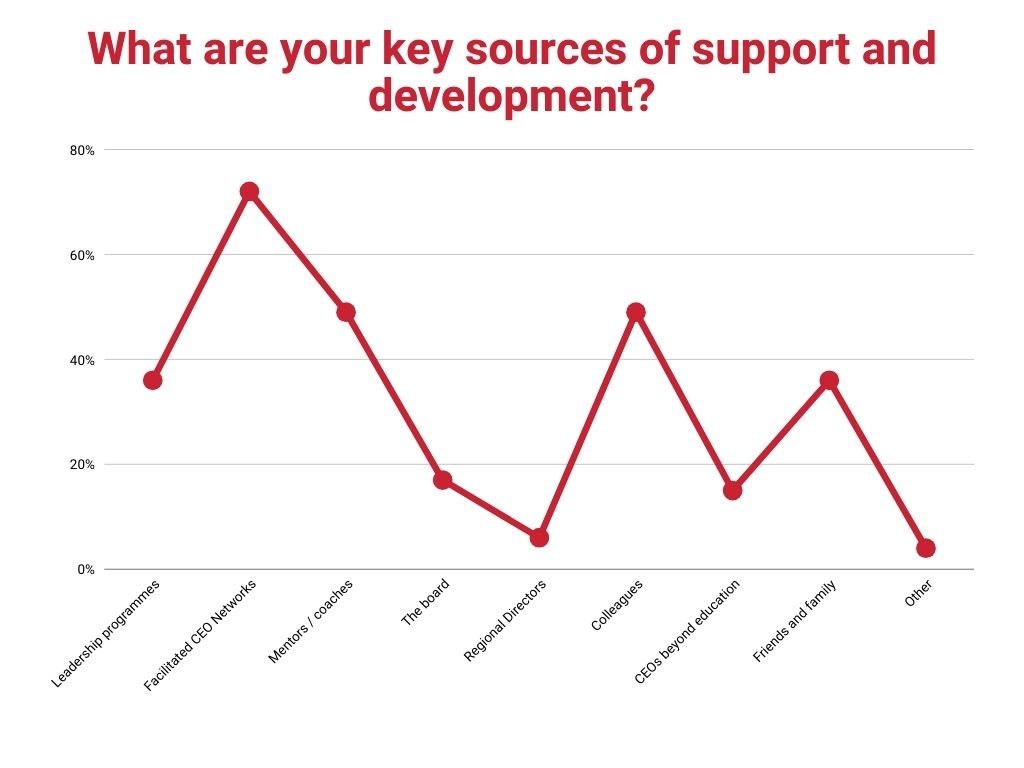
We asked CEOs to name their top three sources of support. Facilitated CEO networks – such as the National #TrustLeaders CEO network – are considered by the majority of CEOs surveyed to be the most valued source of learning and development. This is clearly reinforced for many by access to coaching and mentoring, and more informal support networks of peers and colleagues. Leadership programmes and friends and family also have had a significant impact for many.
Concerningly the role of the board in providing support was cited by only 17%, having dropped significantly down the list this year compared to previous years’ surveys, and the role of Regional Directors in providing support remains very minimal in CEOs’ eyes (6%).
FURTHER READING: National #TrustLeaders CEO Network for academy trust CEOs | Forum Strategy
6. And finally, expectations to growth
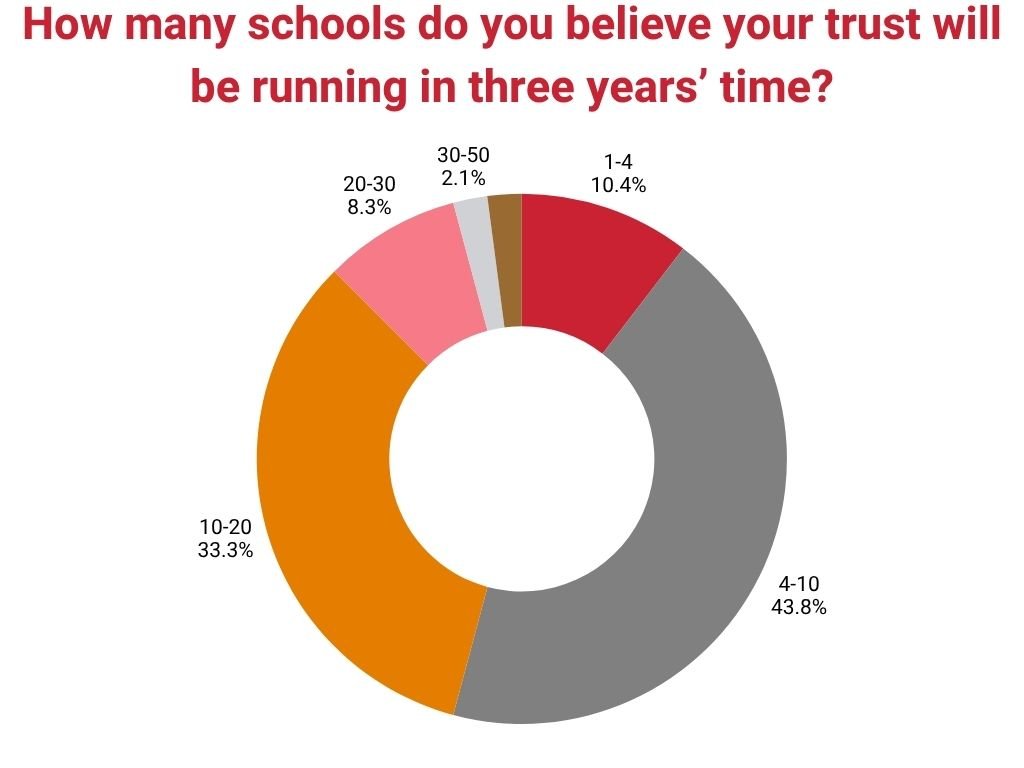
We again asked CEOs about growth in terms of the number of schools they predicted would be part of their trust in three years’ time. Interestingly only a very small number of CEOs believed that they would have thirty or more schools within their trust by that time. Thirty two percent believed they would have between ten and twenty schools, and forty three percent believed they would have between four and ten schools as part of their trust. Five percent believed they would have four or less.
7. A lack of succession planning gives cause for concern
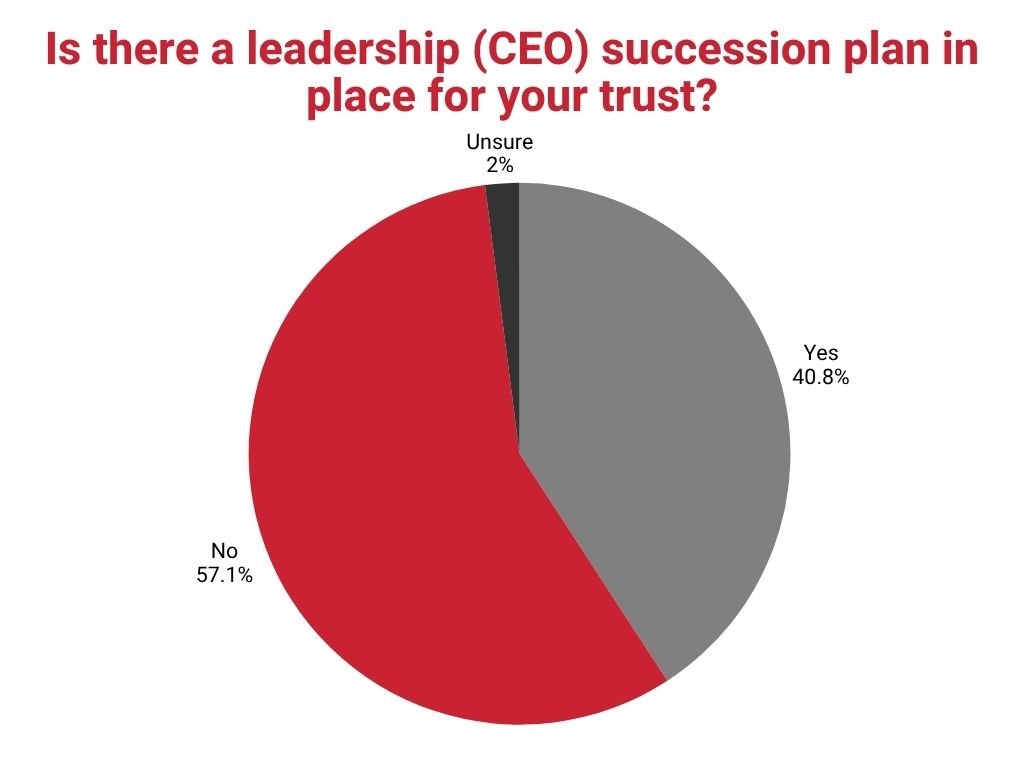
As with previous surveys it remains clear that CEO succession planning is not universal amongst boards. More CEOs than not (59%) said their board did not have a succession planning strategy in place, which is concerning even without taking on board the fact that most survey respondents are already some way into their CEO role. At a time when CEO turnover across the economy is growing, this is a blind spot that many boards urgently need to address to ensure the sustainability and robustness of their trusts into the future. A lack of CEO succession planning is a major risk at an organisational and a sector level; and it is why investing in Deputy CEOs and other executives’ leadership development (such as via the Being the CEO programme) and routine exposure to aspects of the role is a crucial starting point.
TAKE A LOOK: The #BeingTheCEO Programme 2026
The survey includes a range of further insights that will be shared with our members at our next members’ briefing in early January.
#BeingTheCEO Programme 2026
Applications are currently open for the #BeingTheCEO Programme 2026 with Michael Pain and Sir Steve Lancashire. The deadline for applications is 19th December 2025.