
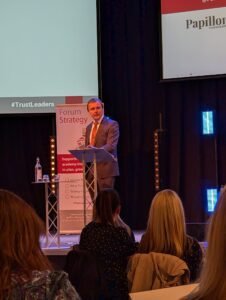
 Michael Pain writes that local governance has always had a bit of an identity crisis. But a meaningful shift has been taking place in community-centred trusts; the white paper has recognised this and looks set to give it even greater momentum.
——–
The role of local governing bodies (LGBs) has always been an area of uncertainty and, too often, lacking sufficient principle or defined purpose. Whilst some academy trusts have chosen to provide LGBs with a significant ‘say’ on issues such as the curriculum, educational performance, and their use of budgets; other trusts have viewed the role more as one of cultural oversight – ‘overseeing’ areas such as school climate, environments, and fundraising efforts.
The first premise to begin an article such as this, is that an LGB is a committee of the trust board. Therefore an LGB’s scope and powers are always devolved (and in theory, returnable) to the board. What a board chooses to delegate to its LGBs is a matter for them and is enshrined in that – often quite unwieldy and almost impenetrable – document called ‘the scheme of delegation’. The Scheme of Delegation is a document that every board member and every LGB member (as well as executive and headteacher) should be highly familiar with. Alas, this is not always the case, and its enduring remoteness (it’s often buried deep on a trust website and in an, often long since discarded, induction pack) sits at the root of the challenges and shifts local governance is facing.
“Local governance in trusts – for all its enormous potential – has too often had an identity crisis.“
So, what are some of the key issues around local governance and how is it evolving? I will explore this, and provide some hints and tips for making the most of local governance, not least as the vision for community-centred trusts becomes ever clearer..
The key tensions for local governing bodies
In some trusts, LGBs have faced a bit of an identity crisis. In part, this comes down to the issue of duplication. Too many trusts – either through a need to convince maintained school governing bodies that joining them won’t come at the cost of their responsibilities, or through taking a default position to LGBs’ role – have given their local governing bodies significant oversight of educational provision and outcomes, budgets, estates, and even HR or technology. This becomes complex when headteachers are also receiving support and scrutiny from the board on these matters and specialist support and direction from executive leaders – all at the same time.
“Duplication across governance and executive disciplines can put already pressurised headteachers in the position of having ‘multiple masters’“
This has at least two notable impacts. First, rather than forming a powerful opportunity for triangulation, it can generate confusion – who really has the responsibility and power to direct schools on these matters? Secondly, worse still, duplication across governance and executive disciplines can put already pressurised headteachers in the position of having ‘multiple masters’. Some of these ‘masters’ may have contradicting the views or expectations to others where there is insufficient alignment. Don’t get me wrong, this may work well in some trusts, but it requires significant alignment of oversight and communication to get duplication of oversight right. Where it doesn’t work, the worst case scenario is exasperated headteachers, dis-enfranchised LGB members who often see their views overruled, and models of improvement at scale that are readily ground down by high levels of duplication and the potential for conflict it brings.
So, where can boards go…?
The opportunity for LGBs to reinforce community-centred trusts
In the first half of this decade, and certainly in the past twelve months, Forum Strategy has been championing the role of academy trusts at the heart of their communities. Indeed, this was the essence of our ‘new narrative for a new decade’ in 2019 and it subsequently formed one of the essential pillars of our ‘thriving trusts‘ model. Why? Because we believe that trusts with strong local identity and connection can better engage stakeholders – including parents, local businesses, cultural organisations, and beyond – in a continuous sense of partnership with their work. This, as we have increasingly argued, generates the necessary social and professional capacity that is essential to overcome the many challenges of our times, including attendance, behaviour, aspiration, wellbeing and community cohesion. But it also does something else, it ensures that communities feel a sense of ownership and involvement in the institutions that serve them and those who matter most to them – children and young people.
“LGBs can become a powerful conduit between the board and communities, and, in an era where local accountability has been increasingly reduced, re-imagine and reinforce it through pure accountability“
As such, we – and increasingly more and more trusts – see a vital responsibility for local governing bodies emerging here. The potential for LGBs in providing a ‘linchpin role’, that represents the voice of the community, connects it with the life and work of the school, informs the board of key trends or changing needs and expectations, and monitors the quality of partnership between the school and its stakeholders. LGBs can become a powerful conduit between the board and communities, and, in an era where local accountability has been increasingly reduced, re-imagine and reinforce it through pure accountability. This contribution to pure accountability means putting the views, ideas, concerns and expectations of stakeholders at the heart of trust improvement and development, whilst at the same time ensuring that the trust’s expectations of stakeholders are also clear. What this does is to finally give LGBs a strong sense of purpose. A sense of purpose and a vital role that can’t readily be replicated by others, be they executive leaders or boards overseeing multiple schools.
It must be said that this is no longer a nice to have or a ‘twee’ take on the role of LGBs, which some may still consider it to be. Policy is catching up. The new white paper has explicitly stated that the government will consult on requiring school trusts to have local governance structures that together include all their schools, hold annual parental forums, and ensure boards hear directly from parents and school communities. This is a shift that is happening, and it looks like it will increasingly be expected of trusts.
The fundamental importance of clear and focused communication between layers
Beyond having a clear, purposeful and uniquely constructive remit, one of the other aspects that tends to lead to successful LGBs is a sophisticated approach to communications that reinforce this. Boards that get this right don’t simply rely on the scheme of delegation – although this is, of course, the constitutional basis for the LGB’s work – to drive the work of good local governance. They articulate the role and responsibilities of the LGBs in plain language, and embed it as part of a clear induction process and through template agendas. They also don’t place all the onus on LGB minutes as an internal reporting tool. These can overwhelm a board to the point it can’t see the wood for the trees, making it meaningless. Of course, minutes need to be made and accessible to the board, but the use of clear and pithy proforma reporting documents by LGBs that reflect the scheme of delegation but also highlight the most important priorities, successes and needs of local schools, as well as ‘real time’ stakeholder voice, is essential. These proforma reporting documents can set out a small but important number of things over one or two pages: what an LGB is proud of; where it / the school are experiencing key risks and need support; what the feedback of the community is like – including levels of community participation in the school’s life; and anything else the LGB feel the board should be aware of.
“Clarity of purpose and purposeful communication is everything when it comes to thriving LGBs that play a vital part in the life and work of thriving trusts.“
This ‘to the point’, proactive and routine approach to LGB/board comms – aligned always with the scheme of delegation – can transform LGBs’ sense of role and agency; as well as ensure that boards are purposefully maximising LGBs’ role to inform wider trust development in a way that other lines of reporting may not do. Indeed, in this spirit, impactful boards make this thoughtful and focused reporting a two way endeavour – adopting a similarly pithy and focused document in their reporting to LGBs, setting out key headline decisions made at board meetings, whether they have taken anything forward from the individual LGB’s report (and how), and anything they believe the LGB should consider or discuss at its own subsequent meeting(s).
Relying on extensive, unwieldy documentation alone such as the scheme of delegation, LGB minutes and board papers is a highly insufficient communication model to generate meaningful and impactful relationships between boards and LGBs. It requires complementary and aligned reporting that highlights key issues, focuses minds, and facilitates the necessary conversations and decisions that lead to impact, and a strong sense of focused agency on all sides. Clarity of purpose and purposeful communication is everything when it comes to thriving LGBs that play a vital part in the life and work of thriving trusts.
Forum Strategy’s top tips for thriving LGBs:
- Have a clear understanding of its role and remit
- Be composed of people who are committed, passionate and add real value to the work of the committee
- Demonstrate a deep commitment to listening to its community and supporting its school and leadership in community partnership, with constructive feedback and challenge too (within its remit)
- Actively contribute to clear, routine, and focused ‘two way’ communication between the LGB and the board, that aligns with the scheme of delegation. No surprises!
- Be a source of advice and support for the trust board on local matters, an encourager of wider trust working and the success of all pupils
- Demonstrate a commitment to the success of every school and pupil across the group
What key issues often characterise an ineffective LGB:
- An LGB that overstretches its remit or whose remit duplicates that of others, causing confusion and uncertainty- especially for heads and staff around who they are accountable to
- There are regular surprises and a lack of clear and routine communication between the LGB and the board
- There is a sense of parochialism amongst LGBs and a failure to recognise that pupils, schools, leaders and governors across the trust are part of the same organisation
FOLLOW UP?
Forum Strategy provides a range of strategic development and consultancy support for trust boards: Board Development | Forum Strategy
The fifth annual National #TrustLeaders Symposium – focused on the potential and emergence of pure accountability – takes place on 3rd June 2026: Symposium 2026 | Forum Strategy
FURTHER READING
Thriving Governance – a think-piece by Michael Pain and Patrick Dunne OBE reflecting on strand two of the Thriving Trusts framework: Thriving Trusts Thinkpieces | Forum Strategy
‘Sir Steve’s take’ on the new white paper | Forum Strategy