 Jonny Uttley, Forum Strategy Lead Associate for ‘Being an Employer of Choice’.
Jonny is an expert-contributor and adviser on the #BeingTheCEO programme, with the fourteenth cohort commencing in September: www.forumstrategy.org/beingtheceo
There is a quiet but profound shift underway in how we think about accountability in education. For a generation, accountability has too often been equated with inspection, regulation, and narrow and – too often ‘high stakes’ – (though important) metrics of success through national performance tables. It is something that has been done to schools and trusts. Helping to secure a certain level of standards and improvement over the last three decades or so — but also, at times, narrowing focus, driving some negative leadership behaviour and exacerbating the fragmentation of responsibility for the things that matter most.
The next decade demands something very different. Not less accountability, but better accountability. Not a weakening of standards, but a strengthening of a much more rounded sense of responsibility —shared, owned, and reflective of a mature trust system.
This is where the concept of Pure Accountability becomes so important – as both a culture definer and as a practical lever.
What is Pure Accountability—and why does it matter now?
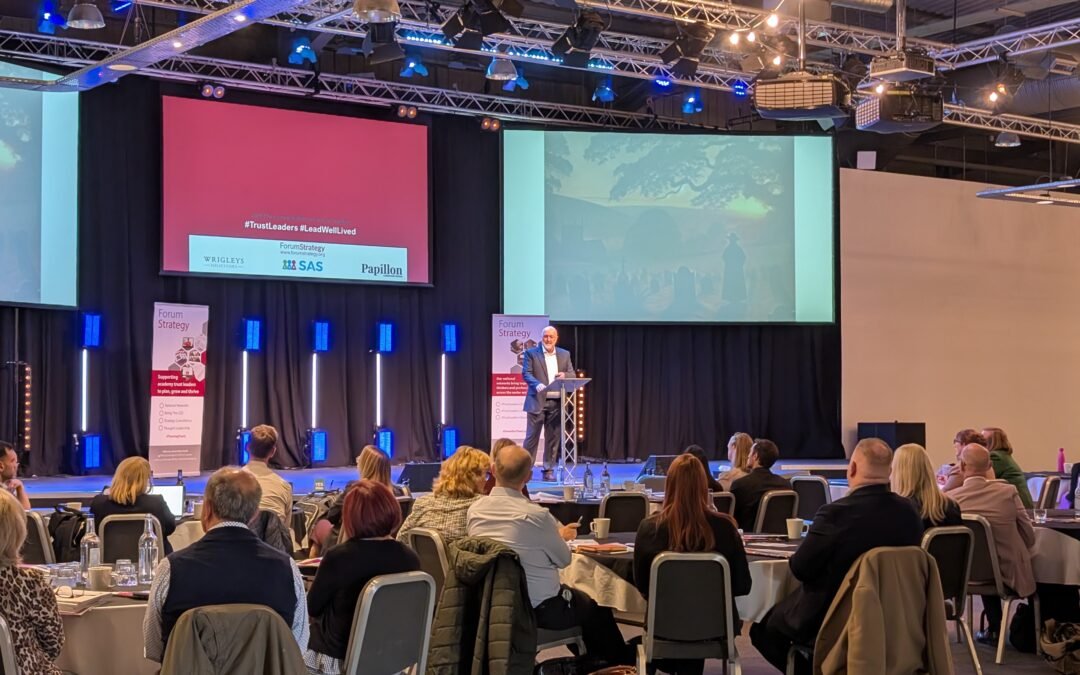
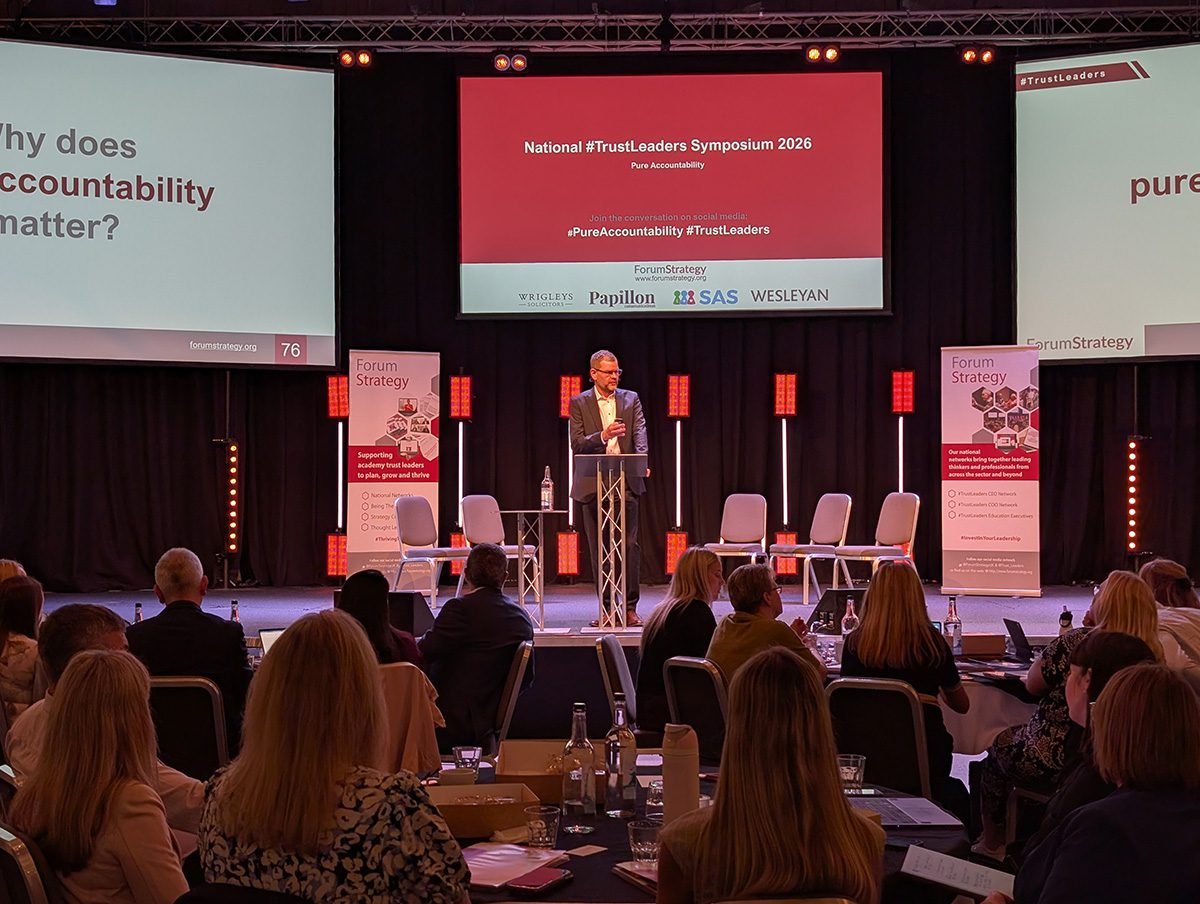
At this month’s National #TrustLeaders Symposium, Michael Pain defined pure accountability as being:
formative accountability forged and sustained by those who are part of a collective endeavour – often at a local level. It generates a shared understanding of thriving trusts, schools and communities; public promises that ensure we progress towards and achieve this; and a shared sense of responsibility in our efforts to make this a reality.
For those of us who lead it, it is about empowering those we serve and work alongside to provide feedback and insights that contribute to the strategic direction, ongoing improvement and responsiveness of our organisations over time. It also helps clarify what our organisations are responsible for, and where others – including communities- are best placed and expected to contribute and take ownership themselves in this shared endeavour.”
He goes on to ask
“What defines pure accountability?
It is formative – it feeds our ongoing learning and growth. It is not judgmental – it encourages openness and vulnerability for that learning. It is real time – it keeps up with progress and need. It reflects a shared vision – connecting accountability with common purpose and ambition
And it is inclusive, encouraging shared endeavour and collective responsibility – because we can’t take on all the responsibility or realise success as single institutions alone.”
Pain, M.; Pure Accountability, latest iteration, 3rd June 2026
Pure Accountability reframes the key question at the heart of public accountability. It asks not, “How are we judged?” but “Who do we (all of us) feel responsible to—and how deeply?”
At its heart, Pure Accountability is about intrinsic responsibility: a culture where trustees, leaders, teachers and support staff act in the best interests of children, not because they are compelled by external pressure, but because they are committed to a shared moral endeavour and vision. It is about the responsibility of institutions to their communities – and, crucially, communities’ responsibility to themselves and their institutions; including families’ and children’s responsibility to participate, give their best, and help inform improvement for the benefit of all. It is accountability that is owned and welcomed, not imposed.
This matters now because the limits of our current model are clearly visible and impossible to ignore any longer. We are still operating within a system architecture created by the Education Reform Act 1988 and subsequent legislation —a landmark set of reforms that introduced market dynamics into the school system: parental choice (and an emphasis on being a ‘customer’, arguably to the detriment of being a sufficiently active ‘partner’) and competition between schools (and later trusts), with performance tables and inspection grades as the currency of quality.
That model has had benefits. It professionalised schools, sharpened focus, drove transparency and, in many cases, accelerated improvement. But it has also embedded a set of assumptions that now constrain us.
- It assumes that competition predominately drives improvement.
- It assumes that most solutions (and therefore corresponding accountability) lie predominantly with public service leaders and institutions
- It assumes that the public is – first and foremost – a customer of the state, not the main agent of changeIt assumes that accountability is best exercised through external and ‘moment in time’ judgement
- It assumes that institutions succeed or fail largely on their own.
So how do we harness and rebalance accountability, in this context, to ensure our organisations thrive, both generally and as employers of choice?
Well, it’s clear, 40 years on, that those assumptions feel increasingly out of step with the complexity of the challenges we face. And the argument for either competition or an emphasis on leaders providing or imposing most of the solutions (and carrying all the corresponding accountability) is undermined by record numbers of NEETs and exclusions, the exponential rise in EHE, and a seemingly intractable crisis in school attendance.
Disadvantage does not respect institutional boundaries. A lack of inclusion cannot be solved by individual schools and trusts acting alone. Workforce challenges are systemic, not localised. And the outcomes we care about—attendance, wellbeing, long-term life chances—are shaped by a web of factors far beyond any single organisation.
If we are going to address the challenges (and opportunities) we face, this re-calibration of accountability is essential
As Michael Pain said in his speech to last year’s National #TrustLeaders CEO conference:
“Diminishing participation, connection, togetherness, and sense of shared purpose or moral endeavour in communities – underpins so many of the issues we face not just as an education system, but as a nation…. too many communities are now either disengaged or feel disempowered, or both. The citizen as customer.”
Michael goes on to say that as a result:
“the complexity of leadership has ramped up enormously. And I think it’s time we are honest – even as people who care enormously and bring huge collective talent and determination and moral purpose, that there are limits. It’s fast becoming unsustainable. In a well-functioning society the state works alongside and in the encouragement of community; but today it is increasingly taking on the traditional responsibilities of community. Good people, good public service leaders are filling the vacuum, but their jobs are becoming harder and more thankless.”
Pain, M. Keynote Speech to the National #TrustLeaders CEO Conference, 18th September 2025
The 2026 Schools White Paper hints at a change. Just two sentences on page 22 signal a potentially seismic shift, as the government proposes “a new model of local partnership and shared accountability for children’s outcomes.” That is a long-overdue reversal of the logic of 1988. It recognises, implicitly, that the next phase of system improvement cannot be driven by competition, it can only come through collaboration – between schools, trusts, health, justice, charities and businesses.
How does the white paper help to take pure accountability forward?
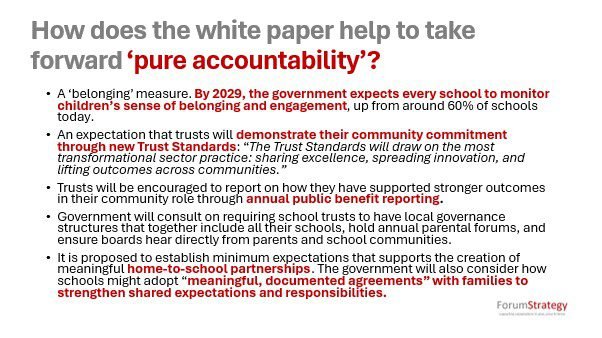
This is heartening. Because Pure Accountability provides the cultural foundation for making the seismic shift required, as it provides a greater balance between vertical and horizontal accountability; a shift from accountability simply as compliance to commitment; from an onus on competition to one of collective responsibility and from institutional glory to community impact
The Covid moment: a glimpse of different accountability
And we have already seen what this looks like in practice. During the Covid-19 pandemic, the formal apparatus of accountability was suspended. League tables were paused. Ofsted inspections ceased. And the usual signals and pressures fell away to be replaced by a different kind of pressure and challenges none of us could have foreseen.
And what happened?
Schools and trusts did not lower their standards. They did not retreat into inertia. They did not stop caring. In fact, quite the opposite happened.
Across the country, school and trust staff demonstrated extraordinary courage, creativity and moral purpose. They organised food distribution for vulnerable families, produced PPE for the NHS and took on contact tracing from Public Health. They kept schools open for key worker children and the most vulnerable under immense pressure. They built new models of remote learning almost overnight. They reached out to communities in ways that went far beyond anything we’d seen before, and beyond what most of us had done before. When narrow, competitive accountability was removed, what followed was truly extraordinary -creative, collaborative and courageous community leadership.
But in that moment, accountability hadn’t disappeared. It had shifted. Leaders were still accountable, but now it was to our communities, to our families, to our staff, to
each other and to our own sense of what was right. And that proved to be a more powerful driver than any external scrutiny.
This is not an argument for abandoning external accountability. But it is a powerful reminder that the deepest and most powerful forms of accountability are internal and relational, not external and transactional. Pure Accountability seeks to capture and sustain that spirit—not just in moments of crisis, but as a permanent feature of how trusts should operate into the next decade.
Thriving trusts and being an employer of choice
In 2023, Forum Strategy published a series of think pieces on “Thriving Trusts” which articulated six elements of a thriving trust:
- A Collective Vision: Galvanising schools and communities to work together in serving the next generation.
- Great Shared and Distributed Governance: Generating even better support, accountability, and both professional and social capital.
- School Improvement at Scale: Fostering the culture, capacity, and systems that make cross-school improvement an organizational habit.
- Being an Employer of Choice: Drawing on collective expertise, resources, and support to build a thriving, well-supported workforce.
- Maximising Public Funds and Resources: Generating greater resources to benefit pupils while working toward environmental sustainability.
- Thriving Communities and Partnerships: Using the trust’s local identity and scale to act as a focal point for area-wide, cross-sector partnerships
At the heart of these interconnected elements is the trust as an employer of choice. This reflects a growing recognition that high performance is inseparable from workforce experience, collective commitment and connectedness across the trust and with its communities. And if Pure Accountability is about ownership of outcomes, then being an employer of choice is one of its most tangible expressions.
But we should be clear: ‘being an employer of choice’ is not a branding exercise. It is not about superficial perks or recruitment campaigns. It is about the lived experience of working in a trust and as a key participant in the life of the wider community it sits within. It is the day-to-day experience of all staff, it is what they say to their family and friends about their work (vocation!) and it is how people feel on Sunday night.
In 2026, many trusts are truly employers of choice. They look and feel different and you can spot an authentic employer of choice when they become:
- A place where people want to come
- A place where people want to stay
- A place where people grow and thrive
- A place that offers autonomy, mastery and purpose
- A place where people make each other better
- A place where people feel part of a wider, inter-connected community
- A place where people make their community better
- A place where people do their life’s best work
And although employers of choice come in all shapes and sizes, it is likely the following characteristics will be present and clearly visible:
- Clarity of purpose: staff understand and embrace the “why” behind the work
- Psychological safety: people can speak honestly without fear; they can be creative and take appropriate risks in their work
- Professional trust: teachers and leaders have agency and are trusted to exercise judgement – within and across schools
- Relational leadership: leaders are visible, human, connected and they are comfortable showing vulnerability
- Authentic listening: staff voice and (honest) feedback is at the heart of decision making and improvement processes
- Sustained development: professional learning is coherent, relevant and not one size fits all
In these organisations, people stay not because it is easy, but because it is meaningful. They feel part of something that matters—and that they matter within it. This is not incidental to performance. It is foundational.
But pure accountability is a two-way street. It is not just leaders who are responsible for creating the culture in which staff can thrive. This is a collective endeavour and accountability is collective too. So, all staff have a responsibility to show up, to give their best, to commit themselves to getting better at what they do and to be always dedicated to safeguarding. We all must contribute to a culture of formative accountability and be willing to speak out when we see poor behaviour. This is last part is crucial – pure accountability requires it.
The potential to redefine culture: CEOs and boards in harmony
There is perhaps no other area of operation where the system’s outmoded model of top-down accountability has done more damage than that of our workforce. Nor is there another area where a trust board and CEO can leverage their creativity and agency for more effectively for positive change.
We all know that the school system has been living through a workforce crisis for many years. We don’t have enough specialist teachers in many areas, one in four new teachers have left the profession by the end of their third year and in the 2026 TES Teacher Wellbeing Report, 71% of teachers say their workload is unmanageable.
And we also know that teachers and school staff don’t feel the same in all trusts and don’t leave the profession at the same rate in all trusts. Trustees, CEOs and leaders have levers they can pull that create cultures where people want to stay, develop and thrive and one of the biggest is rejecting top-down, high-stakes accountability within the trust and protecting staff from the punitive nature of external accountability.
This has to start with the CEO and board understanding what research tells us about the importance of school staff in delivering great outcomes for young people and the evidence about what makes staff stay or leave. Whether boards become familiar with the Sutton Trust Report from 2011 [3], the Kraft and Papay study from 2014 , Becky Allen and Sam Sims superb book The Teacher Gap from 2018 (Allen, B., & Sims, S. (2018). The Teacher Gap. Routledge.) or my own book with John Tomsett Putting Staff First from 2020 (Uttley, J., & Tomsett, J. (2020). Putting staff first: A blueprint for a revitalised profession. John Catt Educational.), (or indeed all of them), understanding that a great teacher in every classroom is the best improvement strategy that exists is the essential starting point.
Edurio’s research shows us that, far from being passive recipients in a national system of top-down accountability, trust Boards and CEOs have enormous agency and hold the keys to great staff experience and retention. Edurio found that 3 of the biggest factors in a teacher’s thoughts about staying or leaving are perceptions of workload, sense of appreciation by leaders and effective communication by leaders. By understanding all this and putting that knowledge and understanding at the heart of their strategy, trust can (and many do) buck the national trends that show a workforce that is struggling, anxious and unsustainable and become trust employers of choice where staff stay and thrive.
Pure Accountability in practice: the employer-of-choice lens
So, what does Pure Accountability look like when applied to workforce? What does it mean as an enabler of an employer of choice culture?
It means that staff experience becomes a part of our core accountability – through our wish as leaders and trustees with autonomy — not a secondary consideration. It means that leaders feel a deep responsibility for the wellbeing, development and engagement of their colleagues. And they care about them as people.
It means that listening is continuous and a core component of our organisational model for improvement and innovation, not episodic. And it means that workforce metrics sit alongside pupil outcomes as a central part of how success is defined.
In this model:
- Staff retention is understood as a measure of organisational health
- Staff engagement, belonging, and motivation is tracked and acted upon
- Performance development processes, including those for the CEO, cease to be top down or done to, and but become a rich ongoing two-way process that is formative and no longer resembles the annual summative download.
- Wellbeing is not something we “do”, it is the result of everything we do – every policy, every system and every interaction that takes place.
Crucially, it also means that trusts do not wait for or rely upon external frameworks to define this work. There is a growing conversation about how the Department for Education and Ofsted should develop a formal trust inspection framework. That will come. But the risk is that we default, yet again, to a compliance mindset—and wait to be told what to measure, how to measure it, and how we will be judged.
The best trusts, like all great organisations across the economy and society, are not waiting to be told how to do it, and to define and measure success. They are defining their own frameworks of accountability—rooted in their values, informed by evidence, and responsive to their communities. And they are already ahead of the system.
They recognise that national accountability systems have a role to play, and measure some fundamentally important things. But the best trusts also ‘measure what they treasure’ – and staff retention, belonging, engagement and wellbeing certainly fits that category.
Learning from practice: within and beyond the sector
There are plenty of strong examples emerging. At Transform Trust (a primary school trust of schools across Nottinghamshire and Derbyshire, led by CEO, Rebecca Meredith) its long-standing staff surveys have evolved beyond a traditional annual HR exercise into something closer to an organisational listening architecture[9]. Too often, staff surveys in education become transactional: leaders ask questions, generate a report, perhaps identify a handful of actions, and then repeat the process a year later. The risk is that people begin to experience surveys as performative rather than meaningful. What is powerful in Transform’s approach is the attempt to create a continuous feedback loop in which listening, response and adaptation are connected. The survey process and CEO Roundtable create mechanisms for understanding not simply whether people are satisfied, but where friction exists in the organisation: workload pressures, confidence in leadership, communication effectiveness, wellbeing, professional growth and the lived experience of culture.
Critically, the value is not merely in collecting the data; it is in creating visibility and organisational memory around it. Trends over time become more important than isolated scores. Patterns can be tracked. Interventions can be evaluated. Leaders can understand whether changes made in one year are genuinely shifting experience in the next. Staff increasingly see a relationship between what they say and what subsequently changes[10]. That matters because trust grows when people believe their voice has consequence. In Pure Accountability terms, this is significant because accountability shifts from being a periodic judgement event to a continuous process of understanding and responding, one in which staff members can play their part through active participation.
Examples outside the sector reinforce the point. Timpson is often cited for its people-first culture—trusting colleagues, devolving responsibility, and building strong relational accountability. Its success is not driven by compliance systems, but by a deeply embedded culture of trust and responsibility. Indeed, James Timpson himself says the only metrics he truly cared about were those that made up The Happy Index. Every April, all employees are asked how happy they are with their area manager or team leader, and each week, they are asked to score on a sale of 1-10 how they are felling.
As Timpson told the BBC: “Lots of companies have these massive surveys, we just ask one question – that’s all we need. That is how we measure the success of the business. It’s not how much money we have in the bank; it’s not our profits. It’s all about the happy index because if the leader has a high score on the happy index, their parts of the business always perform well and make really good money.” Timpson held himself accountable for his staff’s experience, but his employees were also accountable and he was certain that that the Happy Index was the strongest leading indicator of the turnover and profits to come.
While we should be cautious about direct comparisons and education is different. But the underlying principle holds – organisations perform best when people feel genuinely accountable—to each other and to a shared purpose.
Moving beyond competition: It’s now or never
All of this points to a deeper challenge. If we are serious about Pure Accountability, we must recognise and confront the limitations of a system built on competition and a ‘provider/customer’ culture. The legacy of the 1988 Act still shapes behaviour. Schools and trusts are, implicitly and explicitly, positioned as competitors—vying for pupils, staff, reputation and rewards. We see it in Ofsted banners outside schools and in screenshots of coloured dots on LinkedIn; we hear it in claims of being “best in the area”. These are the trappings of a system that has had its day, and they undermine the collective endeavour required to tackle our communities’ most difficult challenges, and to harness opportunities together
Even within trusts, there can be residual traces of this thinking—comparisons between schools, internal hierarchies of performance, “capacity givers” versus “capacity takers”. But the future will require something different. It will require:
- trusts working in genuine partnership with other trusts
- shared responsibility for local outcomes
- collective approaches to workforce development
- openness rather than defensiveness
The White Paper signals a direction of travel to a very different place in its brief mention of shared accountability. We should seize this opportunity, turn away from competition and the emphasis as citizen as customer rather than responsible partner, and instead embrace Pure Accountability.
And again, this can work and there are compelling examples of community accountability we can learn from. In Cincinnati, StriveTogether has built a cross-sector partnership focused on improving outcomes for children from cradle to career. Schools, local government, employers and community organisations share responsibility for a common set of outcomes. This is accountability without fragmentation. It is collective, not competitive. It is intelligent and recognises the complexity of the system. One thing it is not though, is soft.
Because this is not about abandoning standards or accountability. It is about recognising that the problems we face cannot be solved in isolation. Pure Accountability provides the cultural shift needed to make collaboration meaningful, not just structural.
Embedding Pure Accountability: a self-reinforcing model
So how do we embed Pure Accountability in practice? It is built through a set of reinforcing behaviours and systems, underpinned by a culture of high challenge and low threat, rather than through an initiative or single process
A practical model might look like this:
- Clarity of purpose
Define what being an employer of choice means in your trust and how it is the beating heart of your culture. - Deep listening
Build multiple channels. Use surveys and focus groups and don’t forget the importance of informal, honest dialogue right across the organisation. - Radical transparency
Share what you hear and be honest about trade-offs. Be open to challenge and different perspectives. - Deliberate action
Translate insight into visible change. - Sustained evaluation
Track trends over time, not just snapshots. Take a long-term view and think about the legacy of the organisation. - Adaptive leadership
Review continually and refine approaches as context evolves.
Crucially, the CEO must lead and champion this. As the Being The CEO framework reminds us, they are the chief talent officer and culture maker. It cannot be delegated. Over time trust builds and feedback deepens. The culture becomes self-reinforcing and the organisation becomes more responsive and self-sustaining.
Board-level leadership: setting the tone
Trust boards have a critical role to play in all of this. They set the tone for what matters. If workforce experience is not discussed at board level with the same seriousness as Ofsted outcomes or financial performance, it will not be prioritised. Start by sharing the wealth of research and evidence that shows that the single biggest factor in the success of a young person at school, particularly from a disadvantaged background, is the quality of teachers and staff.
Boards should:
- understand that people are the key to success of the trust
- make public promises about what it means to be an employer of choice and what employee can expect and what should be expected of them;
- establish clear metrics of success for being an employer of choice (ideally with an ability to benchmark across schools, with other educational institutions nationally, and with other employers regionally) and that the executive is held to account for these.
- receive regular, meaningful insight; both from staff surveys, but also from general ongoing feedback (collated ‘suggestion box’ insights or local governing body feedback on individual school culture, for example)
- ask challenging questions
- ensure insight leads to action – including demonstrable improvement and innovation – where necessary
- ensure alignment between values and practice
This is not about adding burden. It is about rebalancing focus. If something needs abandoning to make space, then go ahead and abandon.
Developing KPIs: Measure what you treasure
If Pure Accountability is to move beyond rhetoric, it must be visible in what we measure, at school level, executive level and Board level. This raises a fundamental question: should staff experience be an internal KPI that is at least as important as external financial or student performance measures?
And the answer is a very straightforward “yes”.
In measuring the extent to which a trust truly is an employer of choice, it is essential to think about what we are measuring and why. Too often, schools and trusts have fallen into the trap of Goodhart’s law – “when a measure becomes a target it ceases to be a combining both leading indicators and lagging indicators and ensuring segmentation and benchmarking where possible is a strong approach. The image below shows how this can look in practice.
Employer of Choice Trust Dashboard
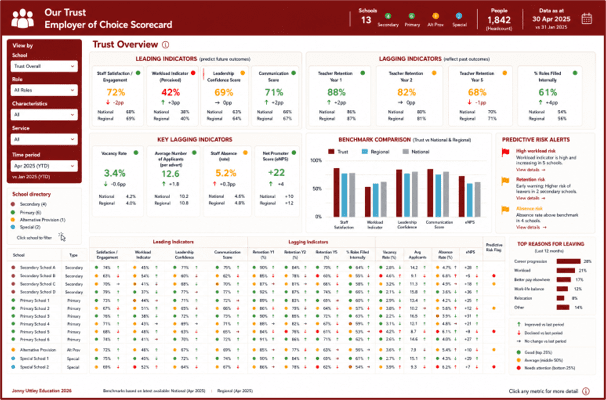
These measures should inform, not punish. Their purpose is to support better leadership thinking and decision making and to know whether the organisation is improving, stagnating or declining.
The next decade: Don’t wait – lead
Looking ahead, there is a critical choice. We can wait for the system to evolve—to see what emerges from the Department for Education, how Ofsted adapts, whether the new model of trust inspection is an improvement on what has gone before.
Or we can lead. Embracing the inspiration to be found from other sectors, from those within our own sector leading the way, and from within our own institutions and communities.
For several years now, many of us have argued for a broader model of community accountability. Its appearance in the White Paper shows that trust leaders have agency and can influence government to make better policy.
And the best trusts are already busy redefining accountability from within. They are building cultures of trust, responsibility and deep listening. They are becoming genuine employers of choice, and they are become truly centred in their communities. And in doing so, they are laying the groundwork for a different kind of system.
One where accountability is not something that constrains us, but something that connects us. One where responsibility is shared, not fragmented. One where the ultimate measure of success is not how we compare to others, but how well we serve our communities.
The next decade will not be defined by structures. It will be defined by culture. Pure Accountability offers a better way forward—not as a policy lever, but as a transformational leadership culture.
It is unlikely the system will demand it.
So, the question is – are we are ready to seize it, design it and own it?
National #TrustLeaders Symposium 2026
Find full details and resources on the #TrustLeaders Symposium page by clciking the button below